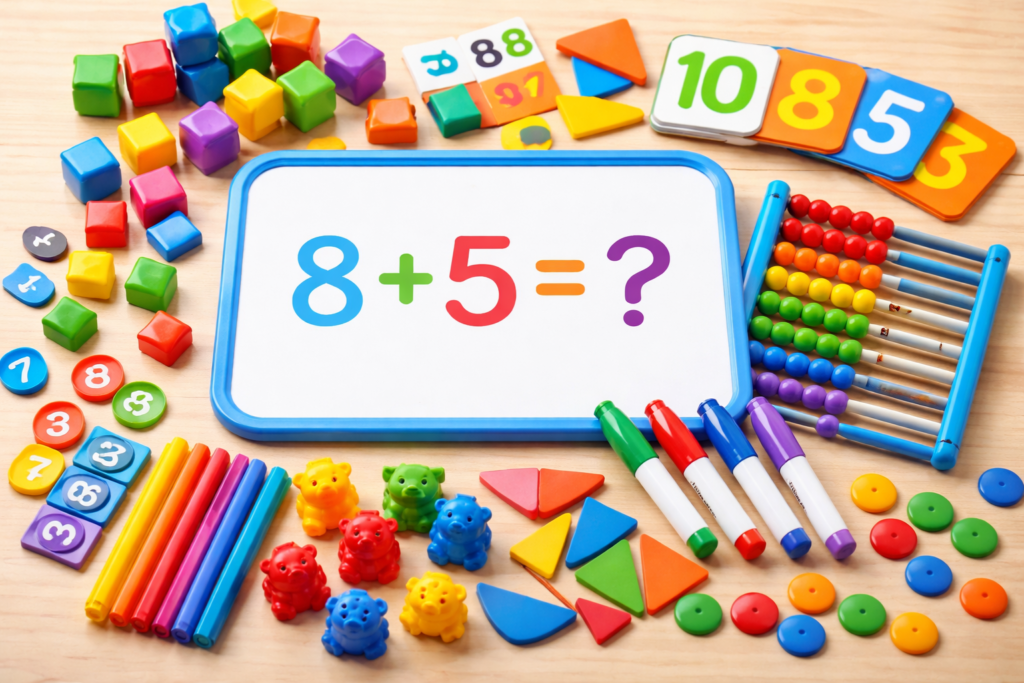
The Education Endowment Foundation (EEF) always produce great resources and ideas for the development of maths. This one (November 2025) discusses the use of manipulatives. This is so important for our teaching, but it reminded me that professional development may well be needed for staff, so this is based on an article by Luke Rhodes, a primary assistant maths hub lead: https://tinyurl.com/ty75y2sv
For specialist teachers of mathematics, manipulatives are far more than classroom resources: they are representations of deep mathematical structures. Counters, cubes, Cuisenaire rods and other concrete tools allow pupils to externalise, test, and refine their mathematical thinking. But purposeful use requires more than availability: it demands mathematical clarity, precision, and high-quality teacher development.
Why Manipulatives Matter
They can serve three purposes:
- Exposing underlying structures (e.g., place value, commutativity, equal grouping, ratio)
- Supporting movement between representations (concrete → pictorial → abstract)
- Revealing misconceptions in real time
Their power lies in how they illuminate mathematics—not merely in the physical handling of objects. Teachers must not only understand how manipulatives function, but why, when, and to what mathematical end they are used.
Guided by the EEF’s Effective Professional Development mechanisms, the school’s approach for supporting staff incorporated the following:
1. Prior learning
Retrieving prior learning is great for our students, but also for teachers: so build sessions with retrieval tasks to strengthen mathematical and representational knowledge held in long-term memory. Staff CPD included:
- definitions of manipulatives
- representation–structure mappings
- common misconceptions linked to specific tools
2. Modelling
Implementation leaders demonstrated manipulatives in real lessons. This allowed teachers to observe:
- purposeful selection of representations
- transitions between representations
- teacher discourse linked to physical action
- pupil interaction with tools as they reasoned and explained
For specialists, this is an opportunity to analyse the mathematical narrative of a lesson—how structure is surfaced, how language is scaffolded, and how reasoning is made visible.
3. Hands-On Engagement to Strengthen Subject Knowledge
Staff then engaged with manipulatives both as “pupils” and as teachers. This dual perspective enabled them to:
- experience the cognitive pathways pupils must navigate
- expose potential misconceptions early
- refine mathematical explanations
- rehearse precise modelling and articulation
4. Structured Action Planning for Implementation
Once staff had explored the mathematics in depth, they collaboratively planned how to embed manipulatives purposefully within their own curriculum. This ensured that teachers took a leading role in shaping these decisions, ensuring coherence across phases.
5. Reinforcement Through Monitoring, Coaching, and Celebration
Sustained impact depended on follow-up. The school implemented cycles of:
- peer observations
- learning walks
- instructional coaching
- celebration of effective practice
These mechanisms helped refine practice, build confidence, and create a culture where manipulatives were embedded—not merely trialled.
Final Thoughts for Specialist Teachers
This article highlights that manipulatives become powerful only when teachers deeply understand the mathematics they represent, grounded in modelling, guided practice, and structured follow-up.
For specialists, the challenge and the opportunity lie in leading this representational work: ensuring that every manipulative used in the classroom is chosen to reveal structure, strengthen reasoning, and help pupils become flexible, independent mathematicians.
I will leave the last word to Joanne Sproul, maths leader at St Peter’s Primary School in Wallsend. I love her CLEAR approach: https://tinyurl.com/4xz3bhte
Consistent rationale and purpose: manipulatives are not an optional extra
but a key part of every child’s maths journey.
Link to learning: resources are chosen to align with the concept being taught,
so they are purposeful rather than decorative.
Explicit teaching: children are shown how to use
each manipulative effectively.
Act as a scaffold: resources are removed once
independence and fluency have been achieved.
Remain visible and accessible across
all classrooms and year groups.