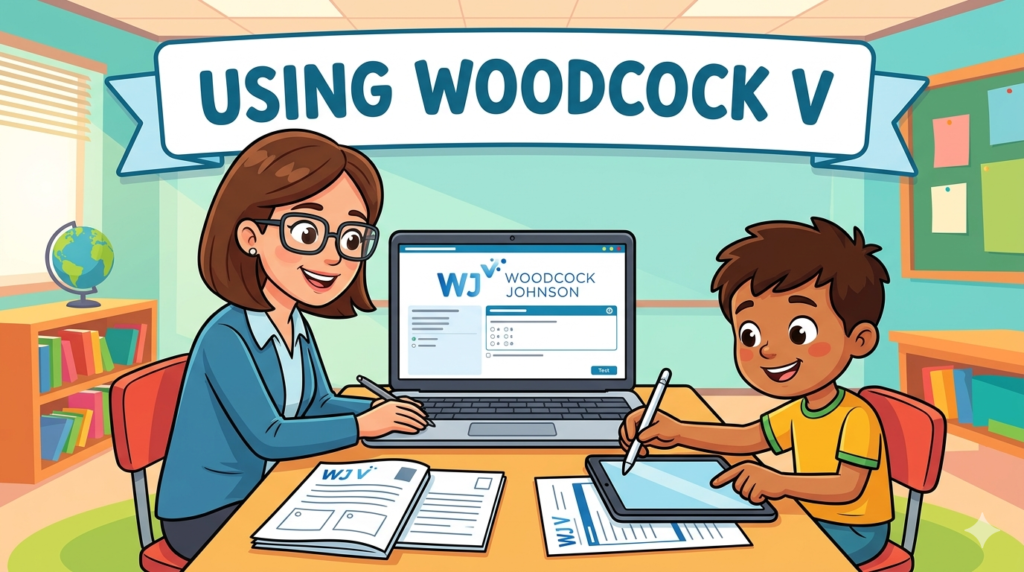
Reflections on Using the Woodcock-Johnson V: Strengths and potential challenges!
Many moons ago, I started using WJ-IV
Here I am again with Woodcock-Johnson V (WJ V), which I have used as a two week trial.
The two week trial offered a valuable opportunity to reflect on both its strengths and its limitations. Like any assessment tool, it brings a mix of efficiencies and frustrations.
What Works Well
- One of the most immediately noticeable advantages of the WJ V is how straightforward it is to administer. The structure is clear, and the digital interface guides you from one section to the next, allowing more attention to remain on the student, rather than the mechanics of the assessment.
- The automatic scoring system is another significant benefit. It removes much of the manual calculation that used to take time and introduce potential for error. Having the scores processed instantly allows for more efficiency, and confidence in the accuracy of results.
- I also appreciated the inclusion of qualitative options that can be quickly selected during testing, ensuring that the assessment captures more than just raw scores. These can then be reported as part of that all-important qualitative information. You can also record the session, so you can look back at it later, but bear in mind your GDPR policy and permissions surrounding this. Please see: https://www.sasc.org.uk/media/kbvj003r/digital-scoring-platforms-for-assessment_guidance-sasc-march-2018.pdf
- The use of a tablet for the stimulus has proven particularly engaging for students. The format feels modern and interactive, which can help reduce anxiety and maintain attention. For students who are comfortable with digital environments, it can make the experience feel less formal and more accessible.
- Another subtle but effective design element is the ability to apply reverse rules without it being obvious to the student. This helps preserve the integrity of the testing process while maintaining rapport. Similarly, the automated application of basal and ceiling rules streamlines administration and ensures consistency, whilst the option is there to change the base of the test, if it is felt that a lower age starting point is helpful.
- The flexibility of the digital system also stands out. When working online, it is possible to dynamically adjust the tests as needed, tailoring the assessment in response to what emerges during the session. Even when working offline, the system remains robust and reliable, which is reassuring in environments where connectivity cannot be guaranteed- as is the case in many schools I work in!
- Regarding replacing other tests, I still want to use it in a few more assessments before I ditch the FAM in particular, but at the moment, I think I will be able to remove the FAM from my SpLD in maths/ dyscalculia assessments!
- And, I won’t break my back lugging around 101 physical tests, manuals, stimuli and associated paperwork.
Please see this link for how it maps very nicely to assessments (more directly with SpLD in maths, than dyslexia assessments, and I don’t usually say that about tests!) You can use it to then map to your other tests, to see where your gaps might lie.
https://ln5.sync.com/dl/83e941660/ip3qgqh5-yn574sq4-xh663ehu-6a2526gj
Challenges
Despite these strengths, there are some drawbacks that can impact usability.
- One recurring issue is the presence of Americanisms. While these do not affect every area, they are particularly noticeable in maths-related tasks. Differences in measurement systems, such as inches versus centimetres, can fundamentally change the answer to a question, from the one given, so these will need to be investigated beforehand. Not a situation that can’t be overcome, but how do I know my ‘estimate’ answer is correct, as opposed to another assessor?
- Another challenge is the tendency to focus more on the laptop than the student. The digital interface, while efficient, can draw attention away from the interaction itself. I found myself not making as much eye contact and maybe missing observing subtle cues. I am sure this will come with familiarity and practice, but something I was aware of.
- Note-taking is also less intuitive than in traditional paper-based administration. Personally, I am used to annotating as I go, capturing immediate observations in response to specific questions. While the system does allow for adding notes or flags to revisit items, it doesn’t fully replicate the flexibility of handwritten annotations. I often found myself needing to write out the question reference separately before making notes, which interrupted the flow and added an extra layer of effort. Again, not an insurmountable problem- I will come up with my own shorthand!
- Finally, the lack of flexibility in an offline setting can be limiting when it comes to adapting the assessment in real time. If I decide mid-session that I want to introduce an additional test, this isn’t possible without being connected online. This reduces spontaneity and responsiveness, which are often important in tailoring assessments to individual needs. This can potentially be mitigated by setting up a superset of everything you might want to do with a particular student, before downloading the offline setup. You do not have to do everything you prepared.
Final Thoughts
Overall, the Woodcock-Johnson V represents a notable step forward in terms of efficiency, standardisation, and student engagement. Its digital features streamline many aspects of administration and scoring, while also offering tools that support professional judgment. I really liked it 🙂
Balancing screen-based interaction with human connection, adapting to cultural differences in content, and finding effective ways to capture qualitative observations remain ongoing challenges for me, but not, I don’t think, insurmountable.
Will I buy it? Yes and I just have: the key lies in leveraging the strengths while remaining mindful of the limitations. With thoughtful use, the WJ V has the potential to be a powerful tool—but it still requires the skill, adaptability, and insight of the professional administering it to truly bring the assessment to life.
What are your thoughts? Will you or won’t you?
Please do get in touch to discuss ways forward with your assessing materials/ practice or to buy some resources to help with your practice- you are not on your own:
- rebecca@educationaccess.co.uk
- 07999 016437
Testimonials: